
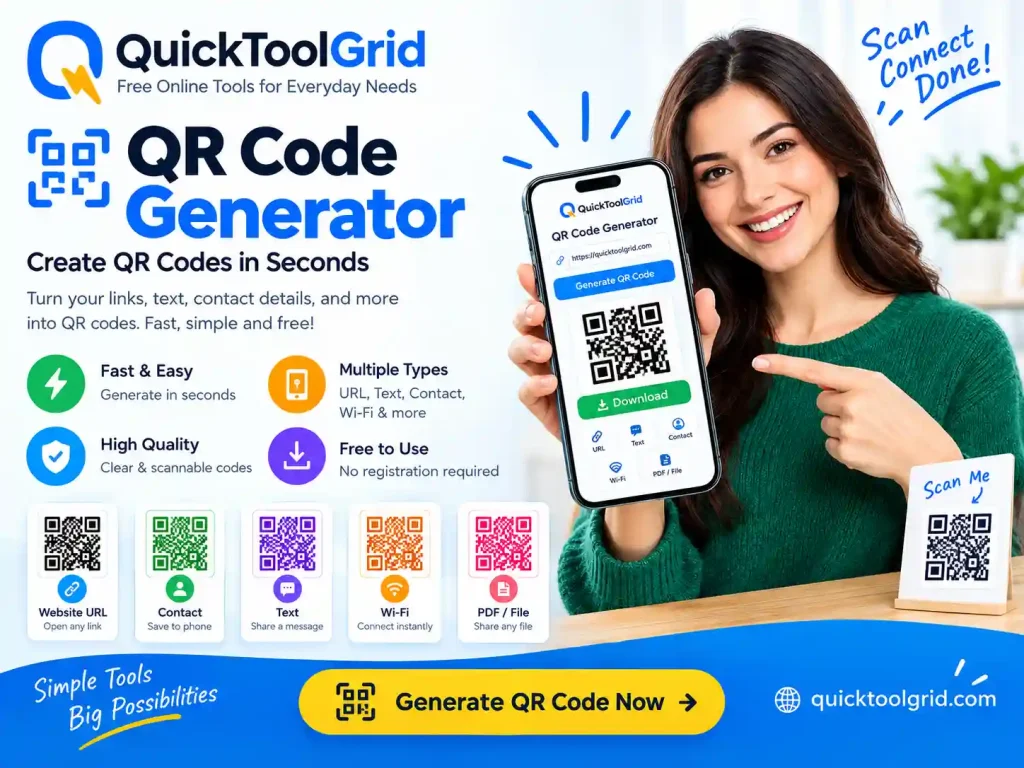
The free QR code generator built for every kind of link
Ten QR types, live preview, gradients, logos, frames and true vector SVG — everything paid tools charge for, free on QuickToolGrid.
Trusted for 10 QR code types · 100% generated in your browser · nothing you type is ever uploaded
Build your QR code
Pick a type, fill in the details, customize the look, then generate. The preview updates as you type.
Customize
Click to upload, or paste an image (Ctrl+V)
Updates automatically
Recent codes
Your last 10 codes, saved privately in this browser only.
Nothing yet — generate a code above.
Bulk generator
One link or line of text per row — generate them all at once, download each as PNG.
Everything the paid tools charge for
Built to match — and beat — the generators that put these features behind a subscription.
Live preview
See the code update as you type, before you ever hit generate.
True vector SVG
Real path-based SVG output — stays crisp from a business card to a billboard.
Real animated GIF
Exports an actual multi-frame animated GIF, not a single static image.
Gradient colors
Two-tone gradients applied across the whole code, not just a filter.
Logo, or a one-click app icon
Drop in your own logo, paste from clipboard, or place a WhatsApp, Facebook, YouTube or Instagram icon in the center instantly.
Eight frame styles
Scan Me, Visit Us, WiFi, Menu, Contact and more — or write your own.
Local history
Your last 10 codes are saved in your browser so you can reuse them fast.
Bulk generation
Paste a whole list of links and get a code for every one.
10 languages
The interface itself translates — not just the output.
How it stacks up
A general comparison against typical paid QR platforms. Always confirm a provider’s current plan on their own site.
| Feature | QuickToolGrid | Typical paid QR platforms |
|---|---|---|
| Price | Free | Free tier + paid plans (~$7–40/mo) for full features |
| Sign-up required | No | Usually, for saving or exporting |
| Live preview | Yes | Varies by platform |
| True vector SVG | Yes | Often paid-tier only |
| Animated GIF export | Yes | Rare |
| Logo + gradients | Yes | Often paid-tier only |
| Bulk generation | Yes | Often paid-tier only |
| Data stored on a server | No — runs in your browser | Usually yes |
Comparison reflects commonly advertised free-tier limits as of 2026 and may not apply to every provider or plan.
Who this is built for
Restaurants & cafés
Digital menus, WiFi access, review links and loyalty cards — one scan each.
Business cards
A contact-card QR code saves your full details with a single scan.
Retail & packaging
Product pages, discount codes, and reorder links printed straight on the box.
Marketing & events
Flyers, banners, check-ins, and social profile links that people actually scan.
Classrooms
Hand out reading links, homework, and resources without typing a URL.
Real estate
Yard signs that link straight to a virtual tour or booking form.
The complete guide to QR codes in 2026
QR codes have quietly become one of the most reliable bridges between print and the web. A scan replaces a typed-out URL, a saved contact, or a typed WiFi password — and most phones now read them straight from the camera app, no extra software needed. This guide covers the ten code types on this page, how to pick settings that actually scan, and where to use them.
The ten QR types on this page
Website opens any URL — the type most people reach for first. Text shows a message directly, with no internet connection needed to read it. WiFi connects a guest’s phone to your network without them typing a password. Email and SMS open a pre-filled message ready to send. Phone starts a call. Contact card saves a full vCard — name, number, email, company — to the scanner’s address book. Location opens the exact coordinates in a maps app. YouTube and Instagram link straight to a video or a profile.
Getting a code that actually scans
A QR code is just a grid of modules with a fair amount of built-in redundancy, but a few choices make a real difference in how reliably it scans:
- Keep strong contrast between the code color and the background — dark on light scans best.
- Set error correction to Max whenever you’re placing a logo on top of the code.
- For print, always export SVG — it’s a true vector, so it stays sharp at any size.
- Print at least 2×2 cm (about 0.8×0.8 in) so cameras can resolve the modules.
- Test the printed code with two or three different phones before a large print run.
- A short frame like “Scan me” next to the code measurably increases how often people actually scan it.
Static vs dynamic codes
Every code generated here is static: the destination is encoded directly into the code and never expires or changes. That’s the right choice for most print use. Paid platforms also sell dynamic codes, which redirect through their own short link so you can edit the destination after printing and see scan analytics — useful for large campaigns, but unnecessary for a menu, a business card, or a flyer.
Privacy
Every code on this page is generated inside your browser. Nothing you type — a URL, a WiFi password, a contact’s phone number — is sent to a server. The history panel is stored only in your browser’s local storage, so it’s private to your device.